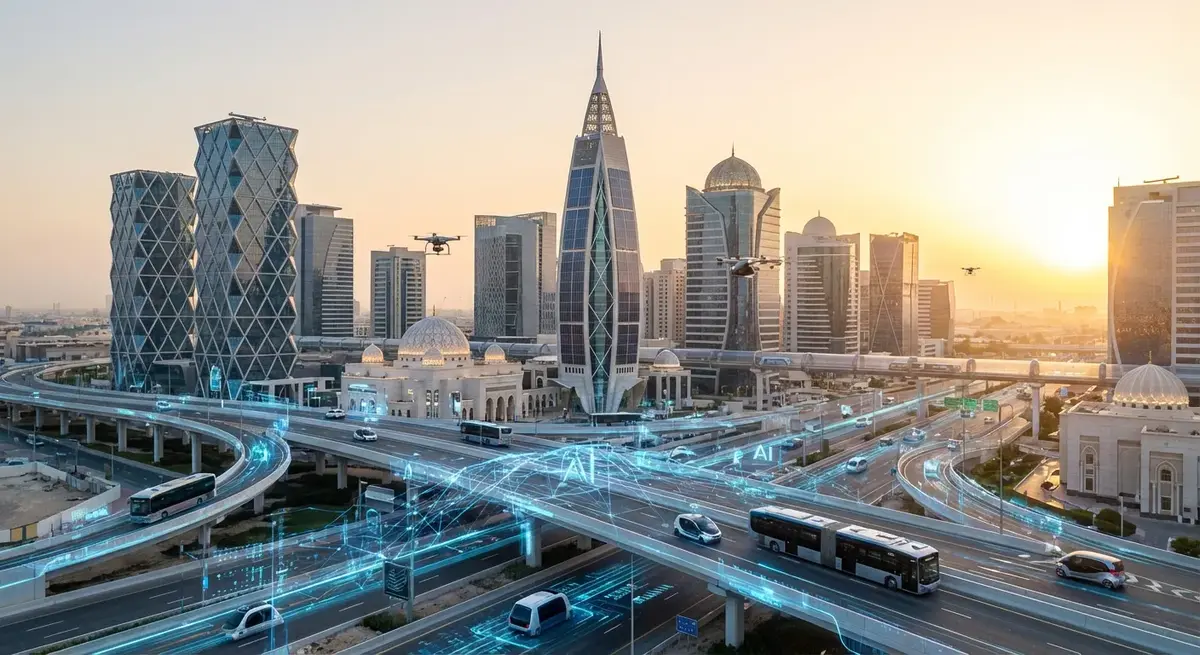
AI Agents in Mobility: How Intelligent Systems Are Reshaping Urban Transport
Picture a typical morning rush hour. Buses stuck in traffic, metros at capacity, ride-hailing prices surging, and thousands of commuters making decisions based on outdated information. Most transport systems today still operate like they did a decade ago. Schedules are fixed, routes are static, and when something goes wrong, it takes human operators minutes or hours to respond.
That's changing. Fast.
What's actually different now
The term "AI agent" gets thrown around a lot, but in transport it means something specific and practical. An AI agent is a system that can observe what's happening, decide what to do, and act on it. Not after someone writes a report. Not after a meeting. In real time.
When a metro line goes down, an AI agent notices within seconds. It checks bus capacity on parallel routes, adjusts frequencies, notifies affected passengers with alternatives, and signals ride-hailing services to expect a demand spike. All of this before most passengers even realize there's a problem.
This is not theoretical. The technology exists today and cities are starting to deploy it.
Why transport is the perfect use case
Transport networks generate enormous amounts of real-time data. GPS positions, passenger counts, traffic speeds, weather, events, payment transactions. Until recently, most of this data was used for reporting after the fact. Now it feeds AI systems that make decisions as events unfold.
The interesting part is that transport has clear, measurable objectives. You want to minimize wait times. You want to maximize vehicle utilization. You want to reduce emissions. These are problems that AI can optimize for simultaneously, something humans struggle with when managing a network of thousands of vehicles across dozens of modes.
Consider demand prediction. Every city has patterns. Rush hours, event surges, weather impacts, seasonal shifts. Traditional planning uses averages and historical schedules. AI models learn from all of these factors together and predict demand at a granular level. Not just "Monday mornings are busy" but "this specific stop will see 40% more passengers next Tuesday because of a concert at the nearby arena, combined with forecasted rain that will reduce cycling."
That kind of prediction changes how you deploy vehicles, how you price services, and how you communicate with passengers.
The hard problems
Getting AI to work in transport is not just about building models. The real challenges are operational.
Latency matters. When someone opens a journey planner, you have maybe 200 milliseconds to compute a personalized, multi-modal route that accounts for real-time conditions. That's a hard engineering problem when you're combining bus schedules, live traffic, bike availability, and walking times into a single recommendation.
Then there's the multi-stakeholder reality. A MaaS platform doesn't own the buses or the metros or the taxis. It coordinates between operators who have their own systems, their own interests, and their own data formats. Making AI work across these boundaries requires careful architecture and, frankly, a lot of patience with integration work.
Privacy is another real concern. Personalization requires understanding travel patterns, but people rightly expect their movements to stay private. The practical solution is to work with aggregated and anonymized data wherever possible, and to give users clear control over what's shared and why.
Where this is heading
The most exciting development is not any single AI capability. It's the convergence. When demand prediction, route optimization, incident handling, and resource allocation all work together as a system, the result is qualitatively different from optimizing each piece independently.
Imagine a transport network that proactively repositions vehicles before demand spikes, automatically reroutes services around incidents, adjusts pricing to balance load across modes, and does all of this while optimizing for sustainability targets set by the city. Each piece exists today. Putting them together into a coherent system is the engineering challenge of the next few years.
Autonomous vehicles will add another dimension. When self-driving shuttles and buses join the network, the AI layer that coordinates between modes becomes even more critical. You need a system that can orchestrate human-driven and autonomous vehicles together, seamlessly.
Why we care about this
At MaaS Solutions, we've been working on mobility platforms since the early days of the MaaS movement. We built Whim, helped cities understand what integrated mobility means in practice, and learned firsthand what works and what doesn't.
The AI layer is where the most impactful work is happening right now. Not because AI is trendy, but because it solves real problems that transport operators and cities struggle with daily. Getting the right vehicle to the right place at the right time, with the right information for the passenger. It sounds simple, but doing it across an entire city at scale is genuinely hard.
We think the companies that will lead this space are the ones that combine deep transport domain knowledge with serious AI engineering. Understanding a demand prediction model is one thing. Understanding how it fits into the operational reality of a city's transport network is something else entirely.
The future of urban transport is intelligent, adaptive, and integrated. We're working to make that real.